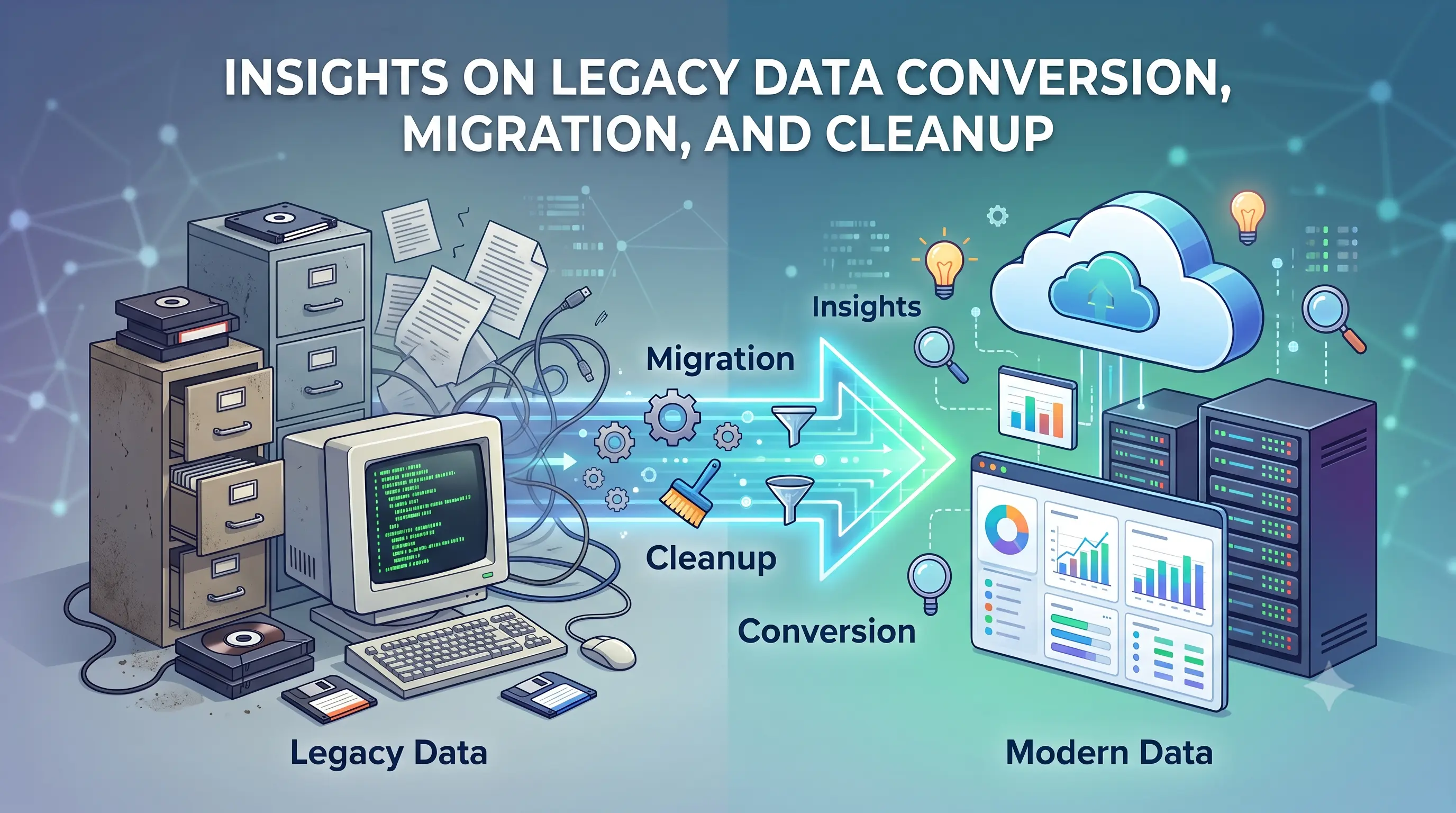
What Is Legacy Data Conversion?
Legacy data conversion is the process of extracting information from outdated systems, documents, and file formats and transforming it into structured, standardized data that modern databases and business applications can use efficiently. As organizations upgrade software, migrate to cloud platforms, or modernize their operations, they often discover that years or even decades of valuable business information remain locked inside legacy databases, PDFs, spreadsheets, scanned documents, text files, and proprietary applications. Converting this information into a usable format preserves historical records while enabling reporting, analytics, automation, and seamless integration with modern systems.
Need help extracting valuable business records trapped inside legacy documents?
Historical PDFs, scanned documents, reports, and spreadsheets contain information your business depends on—but it's difficult to search and even harder to analyze. We convert legacy documents into accurate, database-ready datasets, making your data instantly searchable, easier to manage, and ready for modern business applications.
Understanding legacy data
Legacy data refers to information stored in outdated software, databases, or document formats that are no longer practical for modern business operations. This may include mainframe exports, old accounting software, archived spreadsheets, scanned invoices, PDF reports, text files, printed forms, and discontinued database systems. Although these systems may still contain valuable historical information, accessing and analyzing the data often becomes increasingly difficult as technology evolves.
Why legacy data needs conversion
Many organizations continue to depend on historical records for regulatory compliance, financial reporting, customer support, auditing, and business intelligence. Unfortunately, data stored in legacy formats cannot always be searched, validated, integrated, or analyzed efficiently. Modern applications require structured information with clearly defined fields and consistent formatting. Legacy data conversion bridges this gap by transforming unstructured or outdated information into standardized datasets that can be imported into today's databases and enterprise software.
Common sources of legacy data
Business information can exist in many different formats, often accumulated over decades of operation. Organizations frequently need to convert data from scanned documents, PDFs, Microsoft Excel spreadsheets, CSV files, text reports, legacy database exports, image files, invoices, purchase orders, bank statements, customer records, payroll documents, and proprietary enterprise systems. Each source presents unique challenges that require specialized extraction and transformation techniques.
How the legacy data conversion process works
A successful conversion project follows a structured workflow rather than simply copying information between systems. The source data is first analyzed to understand document layouts, database structures, and business rules. Information is then extracted, standardized, validated, and transformed into the required destination format. Throughout the process, quality assurance checks ensure that the converted data accurately reflects the original records while meeting the requirements of the target system.
What the process usually includes
- Analyzing the original file, document, or database structure.
- Identifying tables, fields, and related business records.
- Extracting information from PDFs, scanned documents, spreadsheets, or legacy systems.
- Cleaning inconsistent values, duplicate records, and formatting issues.
- Standardizing dates, currencies, codes, and text fields.
- Applying business rules and field mapping transformations.
- Validating the converted output for completeness and accuracy.
- Delivering database-ready files such as CSV, Excel, SQL tables, or custom import formats.
Challenges during legacy data conversion
Legacy data is rarely clean or consistent. Different departments may have used different formats, naming conventions, and business rules over time. Scanned documents often require Optical Character Recognition (OCR), while older databases may contain obsolete codes or missing relationships between records. Duplicate entries, incomplete information, and inconsistent formatting can further complicate the conversion process. Careful planning and validation are essential to overcome these challenges.
Benefits for modern businesses
Converting legacy data provides far more than simply preserving historical records. Structured data enables advanced reporting, faster searching, business intelligence, cloud migration, workflow automation, and integration with ERP, CRM, and analytics platforms. Employees spend less time manually locating information and more time using reliable data to make informed business decisions. Organizations also reduce operational risk by ensuring important historical information remains accessible as legacy systems are retired.
Industries that benefit from legacy data conversion
Legacy data conversion is valuable across many industries, including banking, insurance, healthcare, manufacturing, logistics, retail, government, legal services, education, telecommunications, and energy. Any organization that maintains years of historical records can benefit from transforming legacy information into structured datasets that support modern software and digital workflows.
Business outcome
A successful legacy data conversion project preserves valuable business information while making it easier to search, analyze, validate, and integrate with modern technology. Instead of keeping critical records locked inside outdated systems or document formats, organizations gain clean, reliable, database-ready data that supports migration projects, regulatory compliance, operational efficiency, reporting, and long-term digital transformation. Investing in high-quality legacy data conversion helps businesses protect historical information while preparing for future growth.
Turn your documents into valuable business data.
From historical archives and scanned PDFs to invoices, engineering reports, and spreadsheets, we help businesses transform complex documents into structured, database-ready information with thorough validation and quality assurance. No matter the size of your project, we're ready to help.